Embracing Culture Contribution: Redefining Hiring for Diverse Perspectives and Growth
- Danny Wilkinson
- May 11
- 3 min read
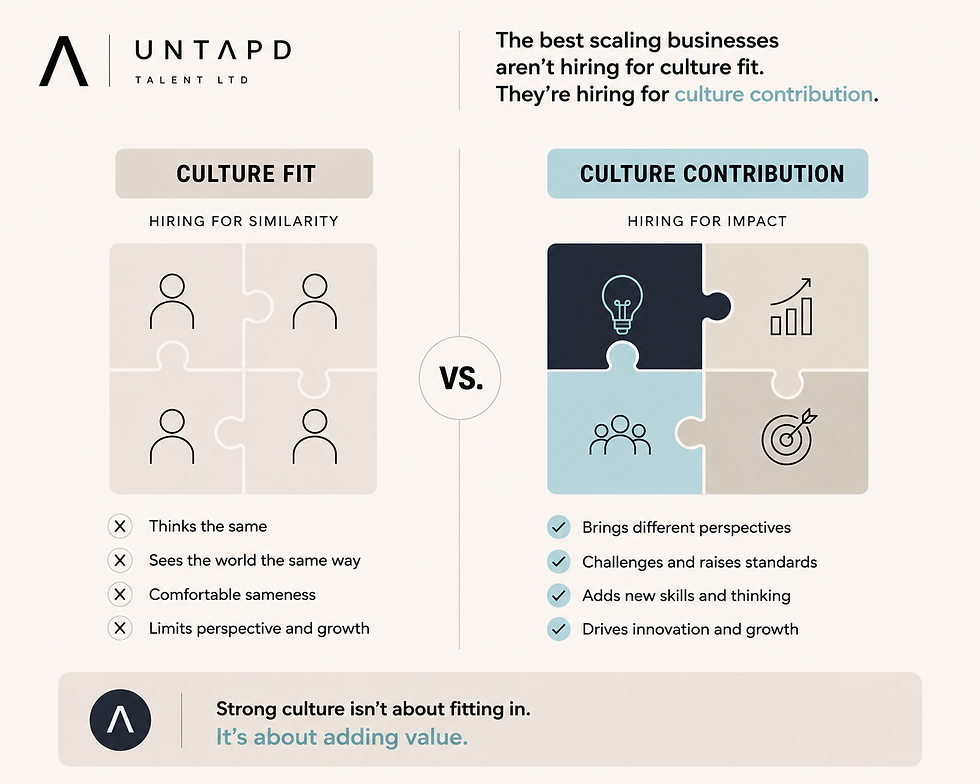
Hiring for culture fit has been a common practice for years. Companies often sought candidates who felt familiar, thought alike, and communicated in similar ways. The goal was to maintain a consistent vibe within teams. But this approach has significant downsides. It tends to create sameness, blind spots, and environments where challenge and growth are limited. Teams that hire only for fit often struggle to evolve as markets and technologies change.
Today, many businesses are shifting toward what can be called culture contribution. Instead of hiring people who simply blend in, they seek those who add value to the culture. This shift is essential as markets evolve faster, teams become leaner, and technologies like AI reshape workflows. Businesses need adaptable thinkers who bring fresh perspectives and new capabilities.
Why Hiring for Culture Contribution Matters More Than Ever
Hiring for culture contribution means looking beyond familiarity. It means valuing candidates who:
Raise standards within the team
Bring different perspectives that challenge existing thinking
Add capabilities the business currently lacks
Constructively challenge ideas to foster growth
This approach helps companies avoid the pitfalls of sameness. When everyone thinks alike, teams miss opportunities to innovate and adapt. Diverse thinking leads to stronger problem-solving and better decision-making.
For example, a tech company that once hired only engineers from similar backgrounds found its product development stagnating. After shifting to culture contribution, they brought in team members with varied experiences in design, marketing, and data science. This diversity sparked new ideas and helped the company enter new markets successfully.
How to Build a Culture That Welcomes Contribution
Strong culture still matters, but it should focus on shared standards, accountability, ambition, and behavior rather than personality types or sameness. Here are key steps to build a culture that values contribution:
Define Clear Standards and Values
Make sure your culture is built on clear expectations about how people work and interact. This clarity helps new hires understand how they can contribute meaningfully.
Train Hiring Teams to Avoid Bias
Interviewers need training on recognizing and reducing hiring bias. This includes:
Understanding unconscious bias
Using structured interviews with consistent questions
Applying objective criteria for assessment
Making inclusive decisions that value diverse perspectives
Without this, companies risk hiring people who feel familiar but do not add new value.
Encourage Constructive Challenge
Create an environment where team members feel safe to question ideas and suggest alternatives. This openness drives innovation and continuous improvement.
Practical Tips for Interviewers to Support Culture Contribution
Interviewers play a critical role in shifting from culture fit to culture contribution. Here are practical tips:
Ask about past experiences where candidates challenged the status quo
Explore how candidates have worked with diverse teams
Use behavioral questions that reveal adaptability and learning mindset
Avoid questions that favor similarity over difference
Include diverse interview panels to bring multiple perspectives
For example, instead of asking "Do you work well with our team style?" ask "Can you describe a time you introduced a new idea that changed how your team worked?"
The Impact of Culture Contribution on Business Growth
Companies that embrace culture contribution see tangible benefits:
Faster adaptation to market changes
Increased innovation through diverse ideas
Stronger team engagement and accountability
Better problem-solving with varied viewpoints
A retail company that adopted this approach reported a 30% increase in new product ideas and faster time to market. Their teams felt more motivated because they knew their unique contributions mattered.
Shifting from culture fit to culture contribution is not just a trend. It is a necessary evolution for businesses that want to grow and thrive in a changing world. Hiring for contribution means building teams that challenge, improve, and expand the culture rather than just replicate it.



Comments